
Why Google Maps Lists Demand "Evidence Optimization" (And How to Do It)
In Short
Why This Matters Now
Local SEO is undergoing its biggest shift in a decade. Google is moving from profile-level updates to evidence optimization—where Ask Maps and local search lists pull real proof from reviews, photos, and web signals to decide who wins.
This shift is already changing how we work as a Google Business Profile agency in Thailand: the profile itself is no longer the whole picture.
I posted on LinkedIn a few days ago about something I'd been finding inside Ask Maps. Lists. Everywhere. Not the conversational answers I went in looking for.
Edward Sturm then read the post out almost word for word in a short. Fair play, he's quick at spotting what's coming. But it's effectively forced my hand. So here's what I actually know so far.
Quick shout-out before I get into it. Darren Shaw at Whitespark, Barry Schwartz who featured this piece in Search Engine Roundtable, and a handful of others in the local SEO community, including people on Reddit, nudged me to dig further into this. Some of what follows wouldn't be on the page without those conversations.
What I'd been tracking: Ask Maps recommendations are weighted heavily by these generated lists. The lists themselves are built from user-generated content, blog-style articles in list format, highly detailed reviews, customer posts with photos and videos, and query-matching language like "atmosphere".
What's puzzling is not everyone can see these lists, so I asked around and figured out how to "command them at will". I then started saving them en masse.
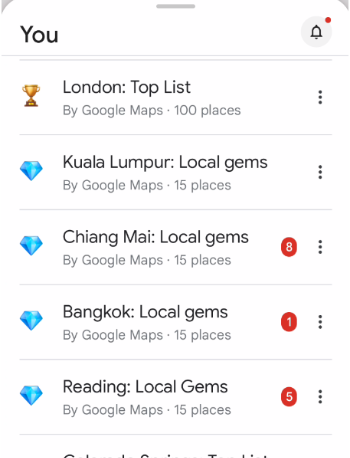
An example from my phone showing how Google Maps lists appear inside the Maps app, including Top List and Local Gems collections.
Maps Lists Are Everywhere and Nowhere
When I started digging into Ask Maps, I was left baffled. Some of the results went against everything I've been preaching as a local SEO for years.
There are lots of lists, but they don't behave consistently. Some appear briefly, disappear, then come back again. Some seem tied to time of day, like lunchtime picks or evening options. Others seem to be built for very specific places, especially tourist areas where Google has enough context to group businesses by intent.
The omissions are just as interesting. Huge tourist towns can be missing entirely. My hometown, Bournemouth, does not appear to have a list yet. Bangkok, on the other hand, does not have Ask Maps yet but does have an overriding set of Google Maps lists. If you zoom into different areas, you find more around Sukhumvit, Khlong Toei, Prawet, and other parts of Bangkok and Thailand. The UK, from what I've seen so far, has far fewer.
I also collected examples from the US while speaking with people there, and those threw up plenty of interesting patterns too. Some lists pull from major publishers. Others seem to lean on smaller local sites, creators, or user-made collections. There is very little obvious rhyme or reason yet, but the types keep repeating:
One odd example was a Lufthansa list for London. It looked like a brand-published travel list rather than a normal Google-generated Maps list, which is interesting in itself. Whether that was written in-house or by an SEO agency, it shows that Maps can surface editorial content from brands alongside its own list formats.
- 🏆 Top List: Area mainstays with the most all-time interest in the Maps community. Best for a spot that's tried and true.
- 💎 Local Gems: Emerging favorites in the Maps community from the past year. Best for dining like a local.
- 🔥 Trending: Places gaining attention in the Maps community this week. Best for discovering the latest hot spot.
- 📰 Publisher lists: Lists from media brands, travel sites, food publishers, and other editorial sources.
- ✈️ Brand/editorial lists: Lists published by brands or partners, like the Lufthansa London example.
- 👤 Individual creator lists: Lists made by individual users, creators, or local contributors.
One US Top List made the pattern especially obvious. Every location I checked referenced some kind of blog-style source, but the lead text was not always a review summary or a publisher excerpt. In one case, it led with a note from the owner before showing supporting links underneath. That's baffling, because some of the restaurants appearing in these lists are not what most local SEOs would call well optimised.
These aren't passive, they change and are growing daily. They look like part of how Google now organises local discovery, potentially for parsing AskMaps 🤷♂️. A business isn't only judged by its profile. It's judged by where it appears, who includes it, what those lists are about, and what evidence and reviews sit around it.
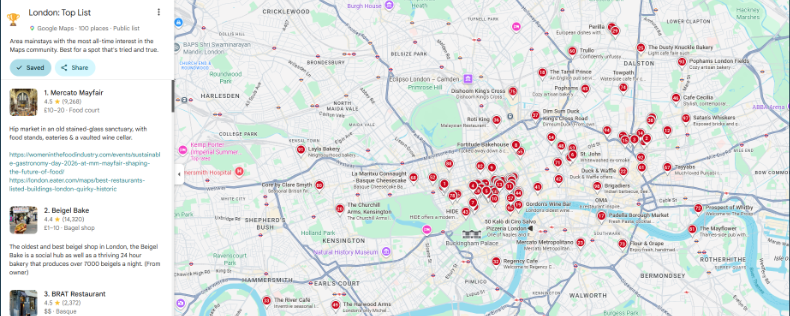
The London Top List in Google Maps, showing 100 places mapped across the city.
Lists Give Google Context
A normal business profile says: "Restaurant in Birmingham." A list says something far more specific:
- •Best places for atmosphere
- •Local gems in this neighbourhood
- •Trending restaurants in this city
- •Good places for a date night
- •Dog-friendly cafes
- •Rooftop bars
Lists turn businesses into answers for specific situations. A user doesn't always search for a category. They search for context. They ask things like:
- Where should I go for a quiet dinner?
- What's good for groups near me?
- Which restaurants have good atmosphere?
- Where can I get party cut pizza?
- What are the hidden gems in this area?
Google Maps lists are how Google connects businesses to those kinds of questions.
The Evidence Loop: How Content Feeds Lists
Lists don't exist in isolation. Some Maps list entries include longer rationales, source links, or wording that lines up suspiciously well with content sitting on the wider web.
That's what I've started calling the evidence loop: (GPT told me to call it that and I like it!)
- A blog post, creator list, or public article describes a business in a certain way
- Users review the business using similar wording
- Customers upload photos and videos that support that theme
- Google Maps organises the business into a list or recommendation
- Ask Maps uses that evidence to answer conversational queries
Working theory. Not confirmed by Google. But strong enough to take seriously.
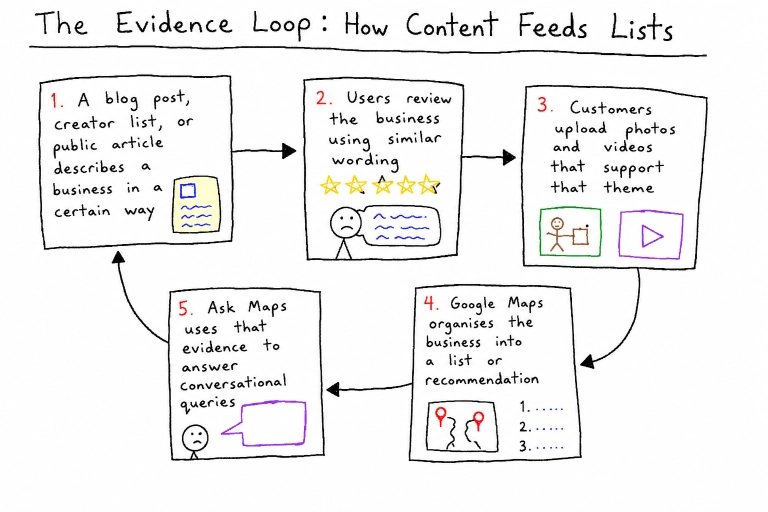
The Evidence Loop: mapping out how content from external sites, customer reviews, and photos feed Google Maps recommendations.
When Evidence Goes Wrong: The Jerry's Tavern Example
A Droid Life writer asked Ask Maps to find new pizza restaurants serving party cut pizza. Ask Maps sent them to Jerry's Tavern in Portland.
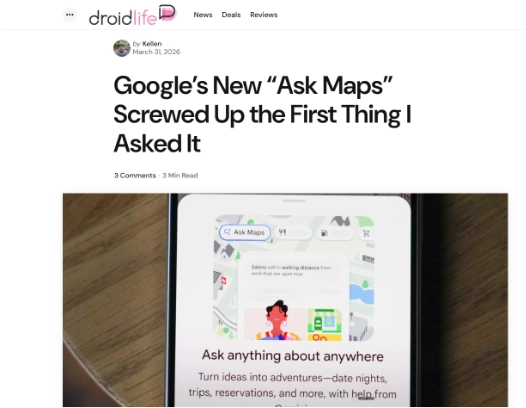
Ask Maps query recommending Jerry's Tavern for pizza despite the business not selling it.
Jerry's Tavern doesn't sell pizza. Jerry, the owner, got attention years ago for making tavern-style pizza during the pandemic, but the tavern itself has never sold it.
When I went and pulled the reviews, I found multiple older ones mentioning pizza directly.
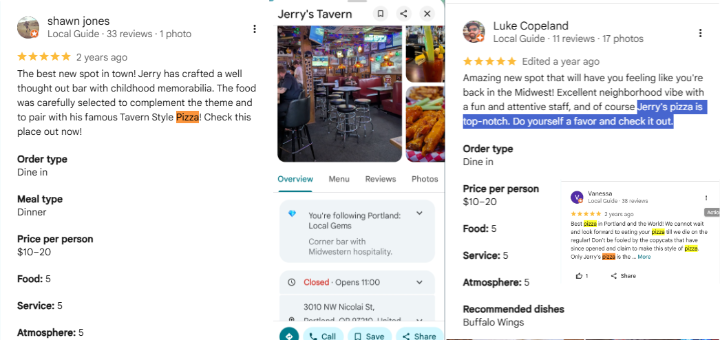
Archived customer reviews referencing Jerry's famous pizza from previous years.
One says "Best pizza in Portland" and "Only Jerry's pizza…". Another talks about "famous Tavern Style Pizza". That doesn't prove exactly how Ask Maps made the call. But it points at something important:
From Profile Optimisation to Evidence Optimisation
Traditional Google Business Profile optimisation asks one question: "Is the profile complete and accurate?"
Ask Maps and Google Maps lists add a second, harder one: "What evidence does Google have that this business is the right answer for a specific query?"
This is why I think local SEO is shifting:
From profile optimisation to evidence optimisation.
That evidence comes from the profile, yes, but it also comes from reviews that mention specific dishes, customer photos, videos, blog posts, and creator lists that group the business with similar places. You're not just optimising what the business says about itself. You're working on what the wider web and Maps ecosystem say about it.
What Reviews Mean Now
Reviews aren't just reputation signals anymore. They're answer signals.
A generic five-star "great place" review is still useful, but it tells Google almost nothing. A review that says "great atmosphere, quiet enough for a business lunch, good vegetarian options and easy parking" is a different animal. That's specific evidence.
The Jerry's Tavern example shows the other edge of this. If old reviews mention something the business no longer offers, those reviews still match future queries. That's a new kind of local SEO risk. Star count isn't enough anymore. You have to know what your reviews actually say — which is exactly what a deliberate review strategy is for.
What Businesses Should Audit Now
Still early research. But the practical direction is already clear. Businesses need to start auditing their local evidence layer:
- Google Maps List Inclusion: Identify which Google Maps lists your locations appear in.
- List Accuracy: Check whether those lists describe your services and products accurately.
- Publisher Mentions: Look for blog posts or articles that mention your business.
- Review Content Sentiment: Audit what your customer reviews actually say beyond star ratings.
- Outdated Services Check: Verify if old reviews mention services or products no longer offered.
- Customer Photos & Videos: Make sure customer-uploaded visuals accurately reflect the current business.
- Ask Maps Validation: Query conversational systems to see if they answer questions about your business correctly.
Run the list. Most businesses will find at least one thing on there that's quietly working against them.
What I'm Still Researching
I'm still testing this. The questions I'm working through:
- How are Google Maps Top List, Trending, and Local Gems generated?
- Do source links in list rationales point back to blog posts or publisher content?
- Do reviews with exact query wording influence Ask Maps answers?
- Can old reviews override newer corrective reviews?
- Do photos and videos strengthen list inclusion?
- Are list inclusions connected to Ask Maps answers?
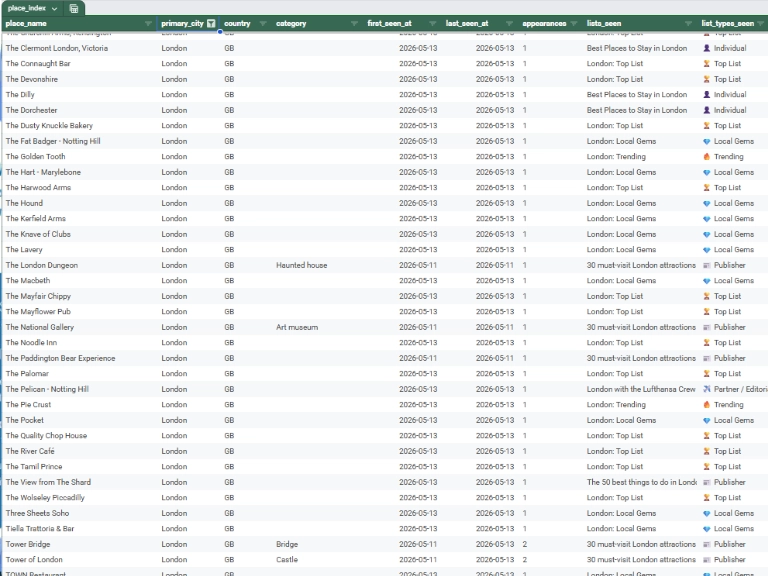
Craig's research tracker detailing correlations between review signals and Ask Maps results.
Which is why I'm treating this as ongoing research, not a finished theory.
The Bigger Picture
Ask Maps is interesting. The lists sitting behind it might be the bigger story.
Google Maps is building a richer local discovery layer: lists, reviews, photos, videos, articles, user-generated content, contextual recommendations. That changes the conversation about what local SEO actually is — and it sits right inside the wider shift toward the agentic web and GEO.
It's not just about whether your profile is optimised. It's about whether Google has enough accurate evidence to know when your business is the right answer. And when the wrong evidence sits there unchecked, Google will confidently give the wrong answer. We saw that play out in our Michelin Google Business Profile case study, where the right evidence layer changed what Google said about the venue.
I've spent over 15 years helping businesses get found on Google. What I'm seeing inside Ask Maps and these lists is a clear shift from profile optimisation to evidence optimisation. The work isn't only on the profile anymore. It's on everything Google can see around it.
That's what I've found so far. And I'm fairly sure this is where local SEO goes next. If you'd like a second pair of eyes on your local evidence layer, you can book a Google Business Profile strategy session.
Found this useful?
Share it with someone working on local visibility.
If this helped clarify how Google is changing local discovery, pass it on. You can also add us as a preferred source in Google so our updates are easier to find when we publish fresh work.
Google will open its source preferences tool. Tick the box next to CTB Digital Marketing to follow the site.